
A small bathroom is not a limitation — it’s a test of efficiency. The core issue in most interiors is not size, but poor planning. Many bathrooms are designed based on trends rather than actual usage, which leads to cluttered and uncomfortable spaces.
The key mistake is focusing on appearance instead of functionality. When approached logically, even a 3–4 m² bathroom can feel spacious and work better than a poorly organized larger one. Below are practical solutions that deliver real results, not just aesthetic appeal.
1. Wall-Mounted Furniture: Free Up Floor Space
Traditional floor-standing furniture consumes space both physically and visually. Wall-mounted units solve both problems.
An exposed floor creates a sense of openness, while eliminating bulky bases reduces visual clutter. This is especially effective in bathrooms under 4 m².
Recommended Option
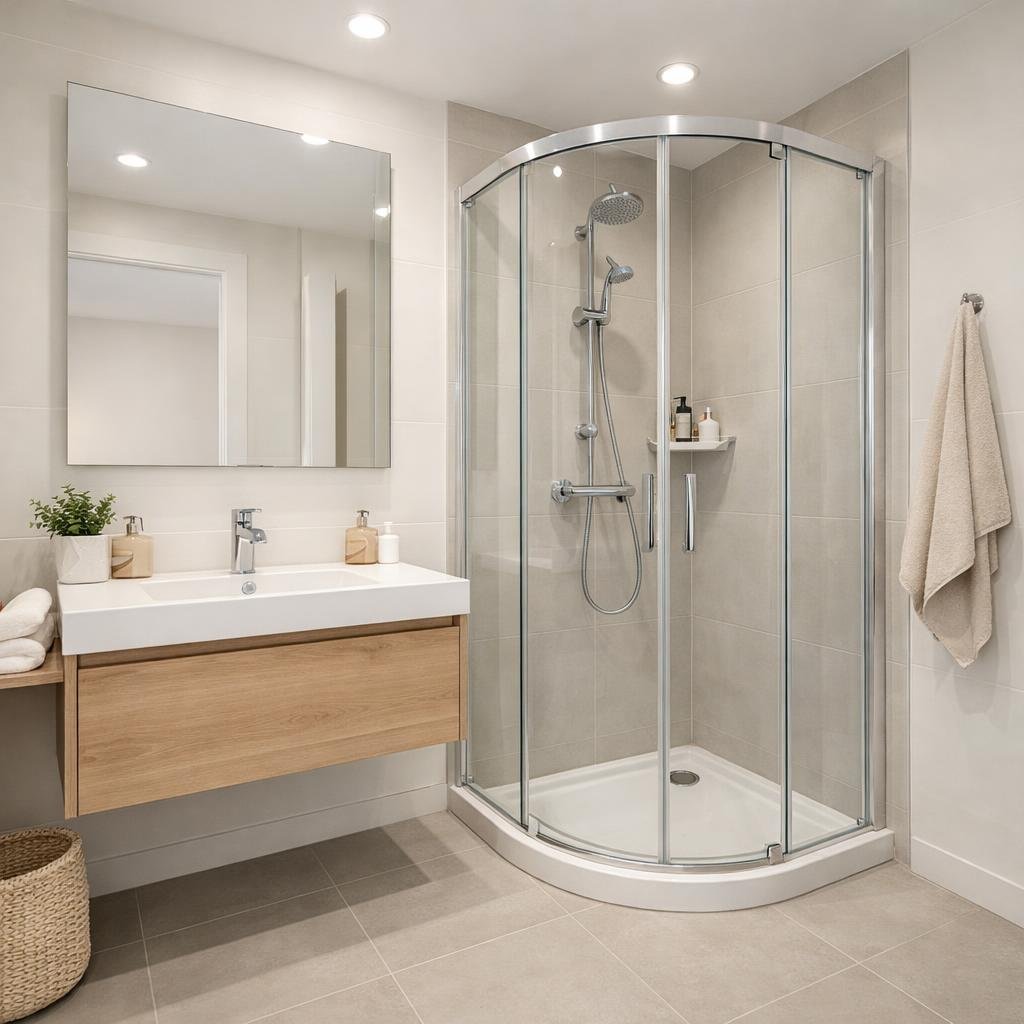
Wall-mounted vanity with sink (depth up to 40 cm)
👉 Check price and options
- Compact depth makes it suitable for narrow layouts
- Built-in drawers replace additional storage units
- Floating design simplifies cleaning and reduces visual weight
Important:
If your walls are not structurally strong (e.g., drywall without reinforcement), additional support will be required. Ignoring this often leads to installation issues.
2. Shower Instead of a Bathtub: Not Always the Right Choice
Replacing a bathtub with a shower is common advice, but it’s often applied without proper evaluation.
Yes, a shower saves space — but only under specific conditions.
When it makes sense:
- Bathroom size is under 4 m²
- You prioritize quick daily use
- You need extra space for storage
When to reconsider:
- You regularly use a bathtub
- There are children in the household
- Plumbing is already configured for a bathtub (modifications increase costs)
Recommended Option
Corner shower cabin with clear glass
👉 View product
- Utilizes corner space efficiently
- Transparent glass keeps the room visually open
- Can save up to 30% of usable space
Critical detail:
Frosted glass may feel more private, but it visually reduces space. In small bathrooms, this works against you.
3. Storage: The Main Source of Clutter
Lack of storage is the primary reason small bathrooms become disorganized. The issue is not the number of items, but poor organization.
What actually works:
- Using vertical space instead of floor area
- Closed storage instead of open shelving
- Separating items by function (hygiene, cleaning, textiles)
Recommended Option
Narrow bathroom storage cabinet (20–30 cm width)
👉 Check availability and prices
- Fits into tight gaps between fixtures
- Maximizes vertical storage
- Helps eliminate visual clutter
Alternative:
If even a narrow cabinet doesn’t fit, consider over-the-toilet storage — one of the most underused areas.
4. Mirrors and Lighting: A Functional Tool, Not Decoration
Most small bathrooms rely on a single mirror and one ceiling light. This is inefficient.
A mirror is not just practical — it directly affects how space is perceived.
Effective approaches:
- Large frameless mirror to increase depth
- Backlit or perimeter lighting to reduce harsh shadows
- Multiple light sources for even illumination
Common mistake:
Using only cool lighting makes the room feel flat, while overly warm lighting makes it feel smaller. Neutral lighting is the most balanced choice.
5. Colors and Materials: Avoid Extremes
“All-white” bathrooms are often recommended, but in practice they can feel sterile and uninviting.
A more effective approach is a light base with subtle contrast.
What works better:
- Light gray, beige, or warm neutral tones
- Large-format tiles to reduce visual fragmentation
- Glossy surfaces used selectively
What to avoid:
- High-contrast color schemes
- Too many textures in a small space
- Dark walls in compact layouts
Conclusion
A small bathroom is not about compromise — it’s about optimization. The goal is not to fit everything in, but to make every element work efficiently.
Wall-mounted furniture, corner solutions, vertical storage, and proper lighting create a cohesive and functional space. The difference comes not from size, but from how intelligently the space is used.
With the right approach, even a compact bathroom can outperform a poorly designed larger one.