

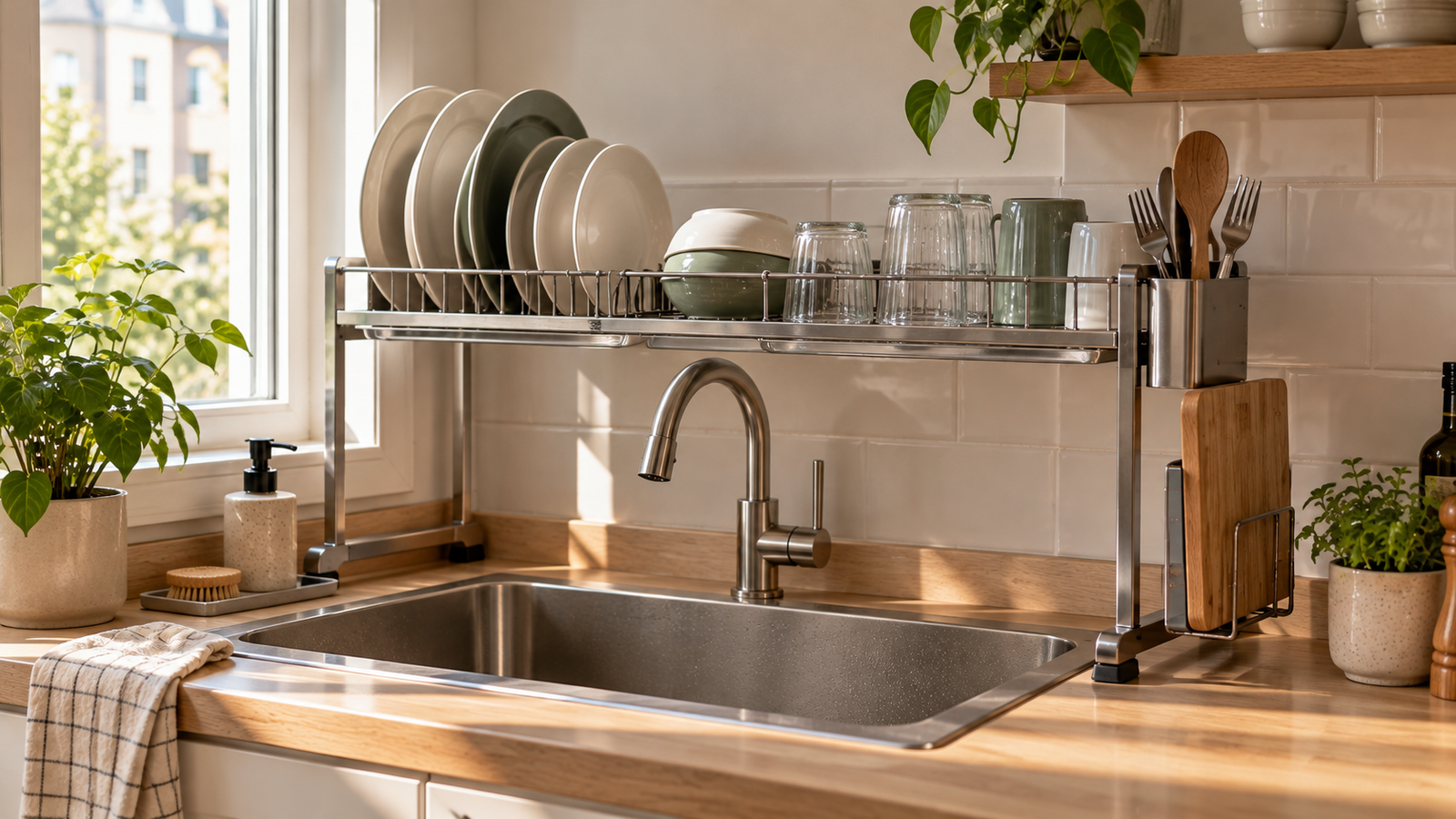
In a small kitchen, the area around the sink often becomes crowded with wet plates, cups, cutting boards, and dish-drying mats. When counter space is already limited, a traditional dish rack can take up room needed for food preparation.
An over-the-sink dish drying rack offers an alternative. It uses the space above the sink to hold washed dishes while allowing water to drain directly into the basin, depending on the design.
However, not every rack fits every kitchen. Sink dimensions, faucet placement, cabinet clearance, weight capacity, and the type of dishes you wash all affect which option makes sense.
This guide explains the main types of over-the-sink drying racks, what to check before buying, and how to choose one for a compact kitchen.
Why Use an Over-the-Sink Dish Rack?
A conventional dish rack usually occupies part of the countertop beside the sink. In a small kitchen, that can mean losing a useful area for chopping vegetables, preparing meals, or placing groceries.
An over-the-sink rack moves the drying area above the basin instead.
Depending on the model, it can provide space for plates, bowls, cups, utensils, and other washable kitchen items. Some designs also include separate holders for cutlery or hooks for small accessories.
The main benefit is not necessarily greater storage capacity. It is the ability to use the sink area more efficiently while keeping part of the countertop free.
You may also like: Best Rolling Kitchen Carts for Small Apartments
Types of Over-the-Sink Dish Drying Racks
1. Roll-Up Dish Drying Racks
Roll-up racks consist of parallel bars connected by flexible joints or a similar folding structure. They sit across the sink and can be rolled up when they are not needed.
They are useful when you want a drying surface that can be removed quickly.
Best for: Small kitchens that need a temporary drying area rather than a permanent rack.
Before choosing one, check the supported load, the required sink width, and whether the material is suitable for repeated contact with water and hot cookware.
2. Expandable Over-the-Sink Racks
Expandable racks adjust to different sink widths within a specified range. Many use extendable arms or a sliding frame to rest across the sink.
This design can be convenient when a fixed-width rack would be difficult to fit.
Best for: Kitchens where flexibility matters or where the sink has an unusual width.
Check the minimum and maximum supported dimensions. The rack must rest securely on the intended surfaces without interfering with the faucet or surrounding fixtures.
3. Standing Racks Above the Sink
Some models use a frame that stands around or over the sink, with shelves positioned above the basin.
These racks can provide more vertical storage than a simple roll-up design. Depending on the configuration, they may include plate holders, cup holders, utensil containers, or shelves for additional kitchen items.
Best for: Households that wash dishes frequently and need a more permanent drying station.
The trade-off is size. A large frame may obstruct the faucet, reduce access to the sink, or make a small kitchen feel crowded.
4. Compact Racks for Small Sinks
A smaller rack may be more practical than a large multi-tier system.
Compact models can provide enough room for everyday dishes without dominating the sink area. They are particularly useful for one-person households, couples, or kitchens where most dishes are washed in small batches.
Best for: Very small kitchens with limited sink and wall clearance.
Before purchasing, check how many plates and bowls the rack can hold in its intended configuration rather than relying only on its external dimensions.
5. Adjustable Multi-Tier Racks
Multi-tier designs use vertical space to separate different types of dishes.
For example, one level may hold plates while another accommodates bowls or cups. Some models also include removable containers for utensils.
Best for: Kitchens that need to dry several types of dishes at once.
These racks require careful measuring. Height, cabinet clearance, faucet position, and access to the sink all matter. A rack that technically fits may still make everyday washing uncomfortable.
Over-the-Sink Dish Rack Comparison
| Type | Main advantage | Main limitation | Best use |
|---|---|---|---|
| Roll-up rack | Easy to remove and store | Limited capacity | Occasional dish drying |
| Expandable rack | Adjustable width | Must fit the sink securely | Flexible kitchen setups |
| Standing rack | More vertical storage | Takes up visual space | Frequent dishwashing |
| Compact rack | Small footprint | Holds fewer items | Tiny kitchens |
| Multi-tier rack | Separates different dishes | Needs sufficient height | Larger dish loads |
How to Measure Before Buying
Measuring is the most important step when choosing an over-the-sink drying rack.
Measure the usable sink width
Measure the distance between the surfaces where the rack will rest. Do not assume that the full width of the sink or countertop is usable.
For expandable models, compare your measurements with the manufacturer’s specified adjustment range.
Check the sink depth and shape
A rack designed for one sink configuration may not sit securely on another. Rounded edges, unusually narrow rims, and uneven surfaces can affect stability.
Account for the faucet
Check whether the faucet sits in the center, near the back, or on the side of the sink. Make sure the rack will not obstruct the handle, spray function, or normal water flow.
Check the height above the sink
If the rack has an upper shelf, measure the distance to overhead cabinets and other fixtures.
You should be able to place and remove dishes without hitting the cabinet or struggling to reach the top level.
Consider the working area
The rack should not prevent you from using the sink comfortably. Leave enough access for washing large pots, filling containers, and cleaning the basin.
Which Materials Are Worth Considering?
The material affects durability, maintenance, and how the rack handles repeated exposure to moisture.
Stainless steel
Stainless steel is a common choice for kitchen accessories because it can be durable and relatively easy to clean. However, quality and corrosion resistance vary, so check the product specifications rather than assuming every stainless-steel rack performs identically.
Silicone
Silicone is often used for roll-up racks and flexible drying surfaces. It can be convenient for storage because some designs fold or roll away.
Check whether the product is intended for the temperatures and loads you expect to use.
Coated metal
Coated metal racks can offer a range of finishes and configurations. Inspect the coating and care instructions, especially if the rack will remain wet for extended periods.
Regardless of material, allow the rack to dry properly and follow the manufacturer’s cleaning instructions.
What Can You Dry on an Over-the-Sink Rack?
The answer depends on the rack’s design and load rating.
Common items include:
- Plates and bowls
- Drinking glasses
- Mugs
- Cutlery
- Small food containers
- Lightweight kitchen utensils
Large pots, heavy pans, and thick cutting boards may require a rack specifically designed to support their weight.
Do not assume that a rack can safely hold every item simply because it fits across the sink. Follow the stated load limits and distribute weight as directed.
Is an Over-the-Sink Rack Better Than a Countertop Dish Rack?
Neither option is universally better.
An over-the-sink rack is useful when countertop space is scarce and the sink configuration allows secure placement.
A countertop rack may be preferable when the sink has an unsuitable shape, when you need to dry heavy cookware, or when you want to move the drying area away from the sink.
Consider how much you wash by hand, how often you use the sink, and whether you need the drying rack to remain in place all day.
If the sink is used continuously by several people, a large rack above it may create more inconvenience than it solves.
How to Keep an Over-the-Sink Rack Organized
Even a space-saving rack can become cluttered if everything is placed on it at once.
A few simple habits can help:
- Put plates and bowls in their designated holders.
- Keep cutlery together in a suitable container.
- Avoid stacking wet items in unstable piles.
- Remove dry dishes regularly.
- Clean the rack according to the manufacturer’s instructions.
- Keep the sink accessible for washing and rinsing.
The aim is to create a temporary drying area, not another permanent storage zone.
Common Mistakes to Avoid
Buying without measuring
A rack that is too narrow, too wide, or poorly supported can be unstable. Check the actual resting points and dimensions before ordering.
Ignoring faucet clearance
A multi-tier rack may interfere with the faucet or make it difficult to fill tall pots.
Choosing more storage than you need
A large rack can obstruct the view and reduce access to the sink. Select a size based on your normal dishwashing routine.
Overloading the rack
Exceeding the stated weight capacity can cause instability or damage. Heavy cookware should only be placed on a rack designed to support it.
Forgetting cleaning and drying
Food residue and standing moisture can accumulate around joints, holders, and corners. Choose a design that you can clean thoroughly.
How to Choose the Right Rack for Your Kitchen
Use these questions to narrow down your options:
Do you wash dishes occasionally?
A roll-up or compact rack may be sufficient.
Do you need to dry several plates and cups every day?
Consider an expandable rack or a stable standing model with dedicated holders.
Is your sink unusually narrow or wide?
Look for a model with a compatible adjustment range, and verify its supported dimensions.
Are there cabinets directly above the sink?
A low-profile design may be more practical than a tall multi-tier rack.
Do you want to put the rack away after use?
Choose a roll-up or otherwise removable design.
Do you regularly wash heavy cookware?
Prioritize a rack with a clearly stated load capacity suitable for those items.
Frequently Asked Questions
Do over-the-sink dish racks work with every sink?
No. Compatibility depends on the sink’s width, shape, rim, and available support surfaces. Faucet placement and surrounding fixtures can also affect fit.
Are roll-up dish racks practical for small kitchens?
They can be useful when you want a temporary drying surface that can be stored after use. Their capacity and supported load depend on the specific design.
Can an over-the-sink rack hold pots and pans?
Only if the manufacturer specifies that the rack can support their weight and dimensions. Heavy cookware may be unsuitable for lightweight or flexible models.
How do I prevent water from collecting on the rack?
Choose a design intended to drain into the sink, position it according to the instructions, and remove standing water during routine cleaning. Drainage depends on the rack’s construction and how it is installed.
Should I leave the rack above the sink permanently?
That depends on the available space and how often you use the sink. A permanent rack can be convenient, but a removable design may be better if you frequently need unrestricted access to the basin.
Final Thoughts
An over-the-sink dish drying rack can help reclaim valuable countertop space in a small kitchen, but the right design depends on the sink, faucet, available clearance, and amount of dishwashing you do.
For occasional use, a roll-up rack offers flexibility. For daily dishwashing, an expandable or standing model may provide more capacity. A compact design is often the better choice when the sink area is already crowded.
Measure carefully, check the load capacity, and choose a rack that makes the kitchen easier to use rather than simply adding another object to it.